Provider boundaries
Mock mode is deterministic. Live MiniMax and OpenAI-compatible providers are server-side opt-ins with host allowlists, timeouts, body caps, and schema checks.
This is the reviewer-facing map for the project: what problem it solves, how the AI workflow is constrained, how cloud persistence works, and which gates prove the production demo.
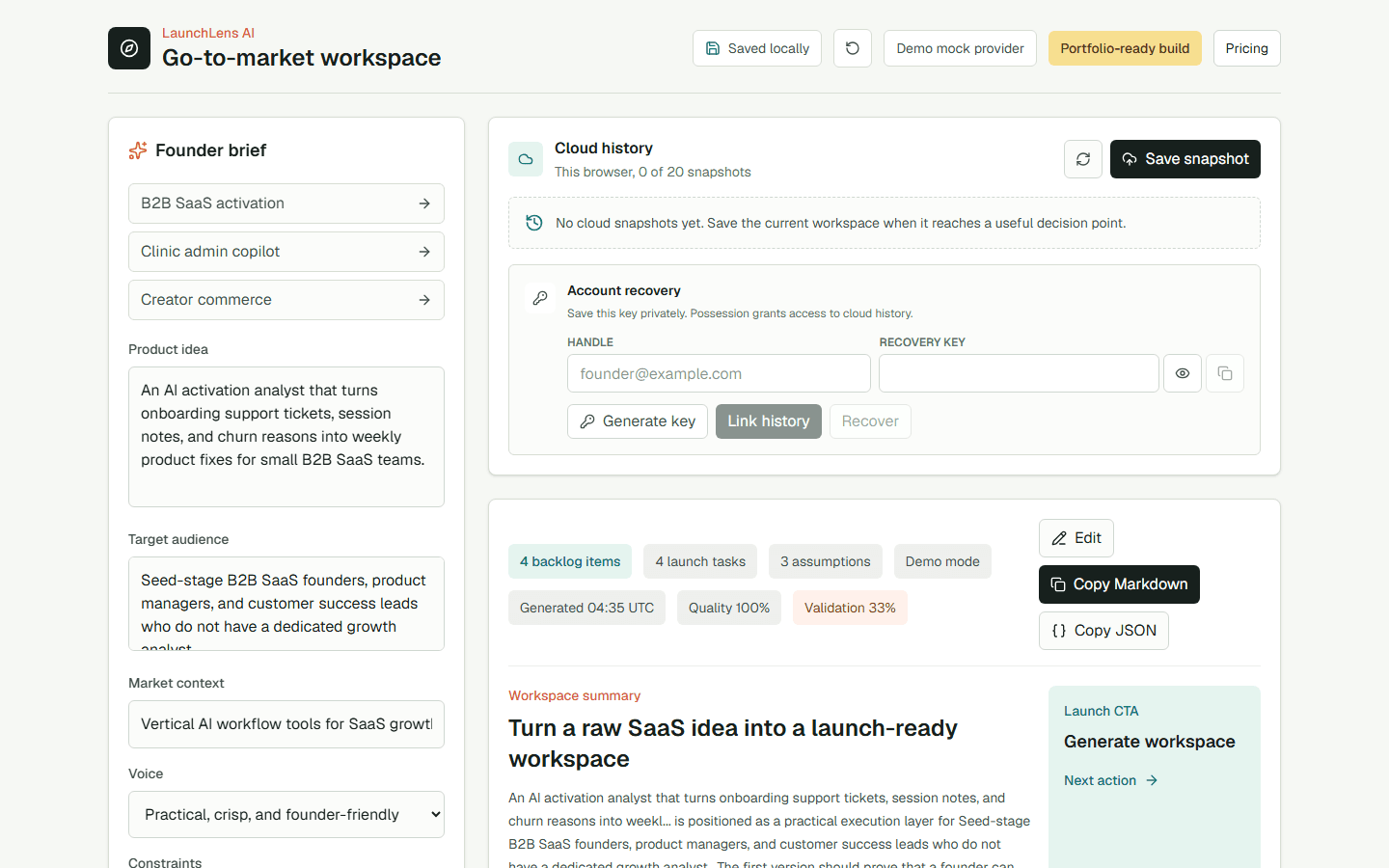
Product loop
A raw product idea starts the flow, with deterministic examples for B2B SaaS activation, clinic operations, and creator commerce.
The provider returns target users, pains, MVP scope, backlog, launch content, pricing, risks, assumptions, and execution tasks.
Each assumption becomes a stable experiment so evidence, confidence, decisions, and next actions do not drift when the plan changes.
The decision copilot can only cite recorded evidence IDs and rejects stale or invented citations before the UI accepts a brief.
Private snapshots, recovery keys, tenant isolation, RBAC, and public-share projections prove the workflow can leave local storage safely.
Engineering signals
Mock mode is deterministic. Live MiniMax and OpenAI-compatible providers are server-side opt-ins with host allowlists, timeouts, body caps, and schema checks.
AI-generated plans are editable, but validation evidence is human state. Decision briefs must cite exact evidence IDs.
Neon-backed snapshots, recovery migration, quotas, and idempotent migrations give the project a real data layer without breaking local-only mode.
Public shares expose summary status and decision state while excluding founder input, evidence notes, sources, owner credentials, and private briefs.
CI, hosted visual regression, post-promotion verification, cloud smoke, and release evidence turn the project into an inspectable artifact.
The live demo, this case study, the written case study, and the demo script are now connected through an explicit portfolio verifier.
Evidence map
`verify:portfolio` keeps this public page, the written case study, README, demo script, runbook, and production packet wired together.
npm run qualitylint, tests, typecheck, evals, build, auditnpm run verify:portfoliocase study, demo script, README, runbook, and production packet stay linkednpm run verify:production-demopublic status plus browser e2e against the live URLnpm run release:cloudmigration, schema verifier, workspace smoke, tenant smoke, and RBAC smokenpm run evidence:releaseignored Markdown and JSON proof packet for the current production SHAFounders can generate ideas quickly, but the hard part is tying positioning, launch scope, evidence, and decisions into one loop that survives handoff.
LaunchLens creates a structured GTM workspace, lets humans add evidence, and then asks AI to synthesize only evidence-cited recommendations.
The next work is not more random features. It is reviewer evidence indexing, commercial-readiness planning, and visible eval drift signals.
Next milestones